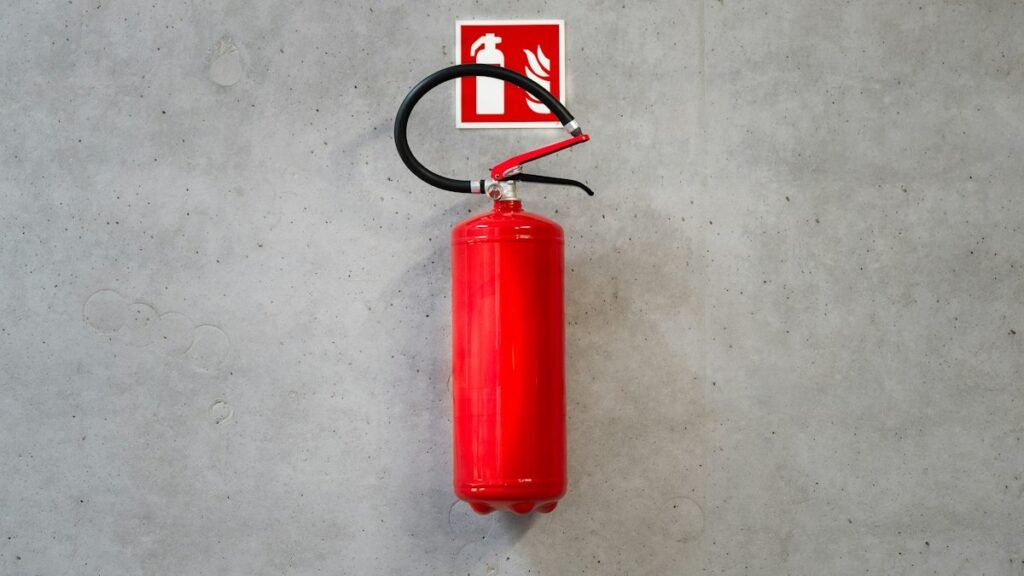
Updated: 15 November 2026. Fire extinguishers should have a visual check every month and a service by a competent technician once a year. Longer-interval services follow at five and ten years, depending on the type. That is the routine in the British Standard for extinguisher maintenance, BS 5306-3.
How often should fire extinguishers be tested?
| Check | How often | Who does it |
|---|---|---|
| Visual check | Monthly | The landlord, managing agent or a member of staff |
| Basic service | Every 12 months | A competent extinguisher technician |
| Extended service (water, foam and powder) | Every 5 years | A competent extinguisher technician |
| Overhaul (CO2) | Every 10 years | A specialist, because the cylinder is pressure tested |
What the monthly visual check covers
- The extinguisher is in its proper place and easy to reach
- The pressure gauge, where there is one, is in the green zone
- The safety pin and tamper seal are intact
- There is no visible damage, corrosion or leakage
- The operating instructions face outwards and can be read
Write the date and your initials in the fire log each month. A missing record is a common finding in a fire risk assessment.
What the annual service covers
- The weight and pressure are checked against the label
- The hose, horn and nozzle are checked for blockage and damage
- The safety pin and seals are checked and replaced
- The body is checked for corrosion and dents
- The service label is updated with the date and the technician’s details
An extinguisher that fails is repaired, recharged or replaced. It is often cheaper to replace an old one than to pay for an extended service.
Who needs fire extinguishers?
Where the Fire Safety Order applies, the responsible person must provide suitable firefighting equipment where it is needed and keep it maintained. The fire risk assessment decides what is needed and where.
- Businesses and commercial premises: extinguishers are normally required.
- HMOs: a fire blanket in each shared kitchen is common. Extinguishers depend on the fire risk assessment and the council’s licence conditions.
- Common parts of blocks of flats: often not provided, because residents are not expected to fight a fire; the fire risk assessment decides.
- Single-household rented homes: not a legal requirement.
Which type of extinguisher?
| Type | Used on |
|---|---|
| Water | Wood, paper and textiles |
| Foam | Wood, paper, textiles and flammable liquids |
| CO2 | Electrical equipment and flammable liquids |
| Powder | Most fire types, but not recommended indoors in small spaces |
| Wet chemical | Cooking oil and fat fires |
Frequently asked questions
How often should fire extinguishers be serviced?
Once a year by a competent technician, with a visual check each month in between.
Do landlords have to provide fire extinguishers?
Not in a single-household let. In HMOs and commercial premises it depends on the fire risk assessment and, for HMOs, the council’s licence conditions.
How long does a fire extinguisher last?
Water, foam and powder extinguishers need an extended service at five years, and CO2 extinguishers an overhaul at ten. Many are replaced at those points.
Is an extinguisher service record a fire safety certificate?
No. It is one of several records that support the fire risk assessment. Read what is a fire safety certificate.
Arrange a fire risk assessment in London
A fire risk assessment tells you what firefighting equipment your building needs. See our fire risk assessment service, use Get a Quote or call 07506 892739.
This article provides general information for England and is not legal advice.